Tuesday, March 15, 2016

Get the tissues, honey

(Note, this post has copious instances of "the f-word," as well as quilty representations of same.)


As most of you know, my mom died in December of 2013. Her death hit me hard, coming just a little less than a year after the death of my brother. I was fortunate to have a wonderful relationship with my mom, and her absence has left me still struggling to figure out what life without her looks like. My mom was one of the funniest people I've ever known, and when I started writing quilting humor professionally, she was always my intended audience. If I thought it would make my mom laugh, I knew it was good.

Earlier that same year, the first Quilt Con happened in Austin, TX and Chawne Kimber's Give A F*ck quilt was on display there. The reaction to this quilt on social media was, shall we say, all kinds of fucked up, as people got offended, expressed their offense, started accusing each other of being terrible people and bad mothers, all while the world kept on turning and no one ever died from a "fuck you" to the head but you wouldn't know that from the way these people reacted.

In response to all this folderol, a group of people got together, inviting other like-minded quilters they knew of, and formed a bee, using a Facebook group as a way to organize. We each made blocks based on our favorite curse word: fuck. It was our way of supporting Chawne's work, stretching the creative muscle a bit, and having fun with new people.


The group held together beyond the making of these blocks. Some members went to the next Quilt Con together. Some came to Maryland last December and had a sew day here in my studio. Our closed (and secret) Facebook group is a place where people can bitch about problems or just celebrate being one of a bunch of fucking weirdos.

I didn't know it at the time, but shortly after my mother died, the other members of the group started talking about making me a quilt. They knew my favorite colors were purple and orange, so they started there, each person making a block or blocks of her choosing in that color scheme. The resulting blocks were set in a gray background. And then—

AND THEN

A giant, glorious, beautiful OCTOPUS


I can't even imagine what it took to draft that beast, to cut it out, to make sure it fit properly. But look at it. It's perfection.

BUT.

This was, remember, in early 2014. After the top was finished, it was given to a longarmer for quilting.

And then it basically disappeared. I can't give more details than that, but suffice to say it looked as though it would never be returned, and there was even some fear that it had been destroyed. But there was no way to know.

Roughly a year later, the group decided to tell me about the quilt.


It was truly the most overwhelming thing, finding out that these people had done something like this for me, something so personal, so tailored for me, and at a time in my life when I needed comforting DESPERATELY.  And it was lost! All that work they had put into it, all the planning, and all they could do was tell me about it and share what pictures they had. 

I was so angry and hurt for them, that someone could treat something so meaningful so cavalierly. And bless them, they never stopped trying to get it back. I even contacted people I thought might be able to help, all to no avail. Until November of last year, when one of the group was able to make some headway and the quilt top was finally returned. 

That same member of the group did the longarming herself and it was sent off to another member to bind. FedEx delivered it yesterday.

This story, hiding as many details as it does, doesn't really express enough about the two-year+ process of making, "losing," and recovering this quilt. And it doesn't really express much about how awesome and funny and unfuckwithable these women are. And it sure as hell doesn't express how much this quilt means to me. It's not just that I can't find the words for it—I don't think there ARE words for it.

I have withdrawn from social life a lot in the last couple of years, and that includes social media, and, by extension, this group. That sense of not quite knowing what my place is in the world anymore without my mother has turned this already introverted person even farther inward. Health problems this past year haven't made that any easier. Colon surgery. Then a frozen shoulder (still frozen, by the way; still hurts—I'm told it can take a year or more to resolve). Now a hernia. And an ovarian cyst. Oh, and some kidney stones for good measure. It's hard for me to be the person I used to be, because I basically hurt all. The. Time. (And I'm allergic to narcotics.) Every time I think I'm moving forward, I get kicked back a little bit. Thankfully, nothing is life-threatening, but I know it has made me somewhat difficult to be friends with.

So, what I really want to thank them for is that, despite all of that, despite me withdrawing and not communicating much and basically being a big giant bummer and not the funny-ha-ha Bitchy Stitcher, they kept loving me anyway. They kept fighting to get that quilt they made for me back, so they could finish it and send it to me. So I could wrap myself in it whenever I feel lonely or weepy or any of those feelings that make me want my mama so bad.


So thank you, Paula FleischerJanet MeaseSam Hunter, Kimberly Brandon RolzhausenAdva Weinstock PriceLinda PayneMelissa KirkMelissa ZawrotnyCaz NowisMaddie KertayFlaun ClineJean MarieMegan NullKim LapacekTrisha Priewe FranklandAlice RidgeChelley Smith BlackBarbara MontejoDeborah Gipe. And Tama Blough, who passed away last year.

Now, if you'll excuse me. I have something in my eye.

Friday, February 26, 2016

Thought of the Day

So, quilty t-shirts are, like, the shizz now. And everybody's trying to get more and more edgy. "I Quilt Because My Anti-Psychotic Medication Isn't Very Effective." "G's Up, Feed Dogs Down." "My Quilt-Related Tattoos Have More Daggers Than Your Quilt-Related Tattoos." Like that.

And, hey, I get it. I have been marginally involved in the quilty t-shirt biz for several years now, plus I love a well-executed, simple design. Like Cheryl Sleboda's Sewing Skull:


But what gets me are these shirts I keep seeing all over Facebook. I have no idea where these come from or who is creating them. And people must looooove them because they get shared a million times.

Ones like this:


And this:


And this:


And I swear, all I can think when I see shirts like those is:


Thursday, January 7, 2016

The Accuquilt Go! A Thorough (and hopefully unbiased) Review (Part Deux)

(Yes, this is super long, but never fear. There will be a handy summary at the bottom.)

As I mentioned in the previous installment, I chose the basic Go! cutter ($249.99) rather than the Baby ($129.99), the BIG Electric ($499.99), or the Studio ($595). And I am going to stop using the stupid exclamation point now. The Go cutter weighs 15 pounds, and when it is open measures approximately 30 inches long by 12 inches wide, not including the protrusion of the crank. The Go Baby weighs 8.5 pounds, according to the website, and looks significantly smaller. I mention this because upon reflection, I am wondering if the Baby would have been a wiser purchase, and I'll be mentioning why as we go along.


The cutter includes a "value die." This is a die that, in one unit, contains blades that cut a 4.5" square, a 2.5" square, and two 2.5" half square triangles.


It also includes a pick (an implement with sharp points on each end for picking out any bits or threads that get caught in the dies), and a 5' x 10" cutting mat.


That's what the mat starts to look like after a bit of use.

I also purchased a triangle-in-square die ($34.99), because this is a block I use a lot in designing, but am not so great at cutting out.


I also purchased the Go Qube 8" which contains 8 dies that can be combined to make 8" quilt blocks (I make 12" blocks out of them, because nobody tells me what to do.) Unfortunately, three of these were redundant as I already had those shapes in that size in the included value die, but I also got a square on point (for making a square-in-a-square, another favorite of mine), rectangles, quarter square triangles, 4.5" half square triangles, a parallelogram, and the ability to cut four 2.5" squares at once rather than just one. The Qube cost $169 and Accuquilt says buying the equivalent dies separately would run about $206.91
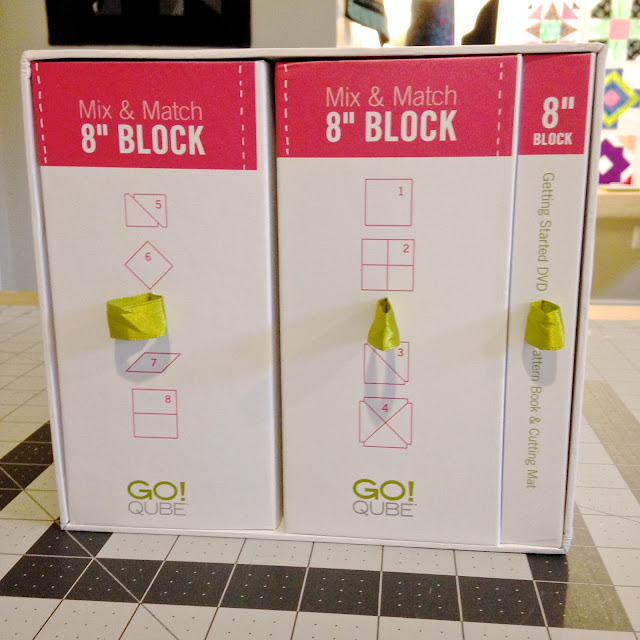

Accuquilt makes the Qube in four sizes (6", 8", 9", and 12"), all with the same shapes, just different sizes for each shape. I chose this one not because I necessarily wanted 8" blocks, but because I tend to use these sizes (4.5" and 2.5" squares, 2.5" and 4.5" half square triangles, etc.) quite a lot. Except for the 12" Qube, all the dies from all the other Qubes are compatible with either the Go or the Go Baby. So far, I haven't yet encountered a die I think I would use that wouldn't have been compatible with the Go Baby, so considering its lower price tag, its lighter weight, and its smaller footprint, the Baby might have been a better purchase. But there is always the chance that there could be a die I MUST have which only works in the Go, so I went with my normal philosophy of "better to have too much than not enough." But then again, that is also probably why I'm fat.

It also includes a DVD, but i have not watched it. Life is too short.

As you can see, the dies from the Qube are square and cut one to four shapes, depending. You can put up to 6 layers of quilting fabric on a die, so you don't have to cut just one square at a time.


Why are the shapes all angled relative to the base (housing? chassis?)? Because the cutter works by passing the die between rollers that press the fabric against the blades nestled down in that foam, and you get a much easier motion and a better cut if the blades pass through at an angle rather than straight on.

But what this means is that you need to be very aware of your grainline as you place your fabric on the die. You need to make sure, even if the piece of fabric you are cutting isn't itself cut along the grain, that you orient the grain of the fabric to follow the straight edge of the die blade. Honestly, at first this threw me for a loop and I thought I'd be constantly ruining cuts by aligning the fabric to the die chassis (base? skeleton? carapace?), instead of the blades, but I got on board pretty quickly. Since the whole thing is new, it's pretty easy to develop the right habits from the start.

Despite the fact that I hate videos, I think this part kind of requires it. They are super short, I promise, and there is no doot dee doot, royalty-free music to endure (though I was very tempted to add the Carmina Burana) or even any talking. It was hard enough to hold the phone and film while also cutting fabric; any narration would have mainly consisted of mumbles and grunts. These just show you the basic process of lining up a piece of fabric on a die and running it through the cutter. (I am uploading these through the Blogger interface. If they don't work for you, I will also post them to Facebook. )


The crank and rollers turn in both directions, so you can use either hand, and you can put the dies in from the left or the right. I think you can see that the crank turns very easily. You do have to give the die a bit of a push to start it through, but nothing major. The cranking does get a bit harder as you add more layers of fabric. I am still able to turn it with the full six layers that they say is the limit even with my bad arm, but it wasn't a tap dance, and my shoulder complained for a bit afterwards. If you have strength or pain issues, fewer layers may be important to how you use it.

A word about the cutting mats. The mats are necessary to give the blades something to push against as they go through the rollers. You wouldn't want them to press against the rollers themselves, because then you'd either be replacing the rollers or replacing dies if the rollers were so hard they dulled or bent the blades. Part of the ongoing expense of having a die cutter is replacing the mats. I have not felt the need to replace either of my mats yet, but I will get some extras when I can just to have them. People complain about this a lot, that the mats get worn and need to be replaced, and often feel that this is either laziness or greed on the part of the cutter manufacturers. Personally, I think this is just the reality of how these machines work. The blades need to be able to cut into the mat a little bit in order to, for lack of a better phrase, get a bite on them. It keeps everything stable while also maintaining the integrity of the blades. Just flip or turn your mat each time you use it, and it will help the blades to cut just a slightly different part each time, prolonging the mat's life. A 6"x6" mat runs about $7 and a 5"x10" mat is about $8. (There are larger mats for larger dies as well, with corresponding prices.)

In every case except one, my dies all give beautiful, clean cuts. For some reason, my triangle-in-a-square die has a spot on one of the right triangles that just misses and leaves one thread attached, so I have to go in and carefully snip it before I remove it. This is not a big deal to me, so I haven't looked into returning it or replacing it. But out of all the dies I have, that's the only one with any issues, and it's a fairly small issue. The dies and the cutter itself are all solid and well-made. The only thing I am keeping my eye on is the crank handle. Initially, I purchased a used Go cutter on eBay, and the crank handle broke off during shipping. I close up my cutter and put it aside when I'm not using it, and I watch the crank carefully as I move it around because it could easily get whacked against a wall or a piece of furniture, and I don't think it would survive.

The main drawback that most people see to the cutter is the potential for fabric waste and the need to plan and prepare fabric ahead of time in order to minimize this waste. When you cut yardage the old fashioned way, with a rotary cutter, you can cut strips to the exact width and then sub-cut your pieces from there, and so the measurements of what you are cutting and what you are cutting from might leave you with leftover chunks.  Those chunks are the pieces that often get put in the scrap bin—too small for the project at hand or to fold up and put in with your yardage, but big enough for something else later. You end up with useable chunks leftover because all your cuts abut one another.

But with a die cutter, as you can see from some of the pictures above, you often have one or just a few shapes on a die, so after you make one cut, you have to move the fabric to place it in position for the next cut. If you are very careful, you can get your next cut quite close to the first one, but there will always need to be a bit of fabric in between, otherwise you run the risk of not getting a clean cut. So you end up with stuff like this leftover:


Now, maybe if I had cut the same pieces from this bit of fabric with a rotary cutter, I would have had a larger chunk leftover. Then again, I might have had a thin strip that I wouldn't have used anyway. It's hard to say.

But as you can see, you can keep a pretty small space in between your cuts and along your edges as long as you are careful when you place your fabric. You can't really use large pieces of fabric, like full yards (well, you can, but the excess fabric gets bunched up and you end up ironing it over and over). So, you will need to cut down your fabric anyway, unless you are using small precuts or scraps, and you can keep these cut pieces only slightly wider than the shape you are cutting. If you are springing for the gigando Studio cutter, which is 30-some-odd pounds and designed to live on its own table and not be moved around, you can get some bigger dies (also more expensive) that will cut many more pieces at one time, all abutted nicely, but then you have a big honkin' machine and no more place to display your collection of ceramic Rick Springfield figurines. The Go cutter does have a few larger dies that cut multiples of the same shape, such as this one that cuts 12 HSTs at a time (more if you use multiple layers), so these could be useful if you determine that the sizes and shapes available fit your needs well.

I find the variety of dies suits me fine. I was pouting earlier in the day because they didn't make a half rectangle triangle that finishes at 4 inches, until I realized that the right triangles from my triangle-in-a-square die would accomplish that very thing. Currently, the Accuquilt website lists 99 appliqué dies, only one of which wouldn't work in a Go or Go Baby. Appliqué dies aren't really my thing. I love appliqué, but I prefer hand appliqué, and these dies do not allow for that; they assume you are going to do fusible, which is a perfectly valid lifestyle choice. 214 dies altogether are available for the Go and 137 for the Go Baby.  (The Studio has 441!)

Besides how easy it seems to be on my shoulder, my favorite aspect of the cutter is that I am now making excellent use of my scraps. These are my scrap bins:


I have always wanted to make better use of them, and while there are certainly myriad ways to use up scraps, the cutter seems to be working the best for me. In fact, I've been working on a Block of the Month-type project using my Accuquilt and these scraps that I want to share with you soon. You won't need an Accuquilt to do it, but I'll have instructions for cutting with and without it, so everyone can play. I promise it'll be super-shenaniganny.


Summary:

PROS:

  • Solid construction
  • Good website and usage info
  • Easy to turn, even for stupid, traitorous shoulder
  • Lots of dies
  • With practice, can produce lots of pieces fast, even with single-shape dies


CONS

  • Expensive
  • Mats need replacing (true of all systems)
  • Potential for fabric waste (true of all systems, and can be minimized)
  • Can't use dies from other systems
  • Doesn't have a setting to play the Carmina Burana when you're feeling dramatic.


As with anything, your mileage may vary; your needs and the way you prefer to sew may be entirely different. I certainly wouldn't push an expense like this on anyone who wasn't already wanting one or who didn't already think it might fill a need. It helps to analyze the sizes and shapes you use the most, and see if the cutter system you are interested in has dies for those. All in all, I am loving mine right now, and I feel like its definitely going to help see me through until I can comfortably use a rotary cutter again.

Which I will probably use to saw off my left arm so I can hurl it off a cliff and watch as is bounces off the craggy rocks on its way to drown in the cold, grey sea.

Stupid shoulder.

Tuesday, January 5, 2016

The Accuquilt Go! A Thorough (and hopefully unbiased) Review (Part One)

Well, it finally happened. No, not that. Not that, either—what are you thinking? No, I mean that after a few years working within the Quilt Industrial Complex (and then basically showing it my middle finger and walking away from it), I have finally been Offered Stuff. For free. In exchange for...something undefined. We never got that far.

I'm not going to say what the product was, and I hope the marketing person who offered it to me understands that I am not shaming her or her company. Companies do have to market themselves, and one way to do that is to get the product out there where it can be used and mentioned by people with an audience. I totally get that. And I also get that quilting is an expensive hobby and it's nice to get free stuff. For many people in this industry, who make an actual living at quilting and pattern writing and such, those inherent expenses can be career-breaking unless they develop a relationship with certain companies who can supply them with fabric and other necessities and offset some of that cost.

And while I do occasionally write and sell my own patterns, it is not a big enough enterprise for me to really justify free stuff for it. I mean, I can barely be bothered to blog about my actual sewing, since most of it is experiments that end up in the reject pile. I can see why a company would want me to use and promote their stuff. I do have an audience, and it's a pretty engaged audience as well, and that's what marketers generally look for. I'm frankly surprised that after all this time someone out there only just now picked up on that.

I won't go into all my reasoning, because I tend to get long-winded about this stuff, but I just don't want to be a representative of anybody but me. When I tell you "this is what I think," I want you to know that it is actually what I think and not what I've been paid or otherwise influenced to say.

I do realize that I probably overthink this stuff, but I have a hard enough time getting a good night's sleep as it is—I don't need questions of minor ethics plaguing me at night. So I chose to decline their kind offer. Because the review I'm going to do today (about a totally unrelated product) is the only kind I really want to do. I bought something with my own money because I wanted to see if it would fill a need. And now, I can tell you all kinds of things about it without consciously or unconsciously censoring myself, because mama don't owe nobody nothing. (That's three negatives; I think that works.)

So, without further blather:

The Accuquilt Go! Fabric Cutter: A Review


I have had my eye on one of these things for years, but couldn't commit to laying out the scratch. The main reason I was interested in it was accuracy. I am kind of a freak about having my pieces line up properly. See this magnificent beauty?


That's several years of practice right there. So, the accuracy I have been trying to accomplish has actually become attainable, and I thought perhaps a die cutter was no longer necessary or desirable.

Then my shoulder decided to be a total bitch.

About two months ago, I started having problems with my left shoulder, and, being the sort of person I am, decided what that shoulder obviously needed was yoga. Helps with all kinds of other things, so why not this? Instead, it got worse. I lost a lot of range of motion and many normal tasks just hurt like hell. I saw an orthopedist who injected my shoulder with steroids and sent me home with a stretchy yellow band and a sheet of exercises to do for six weeks. If it wasn't better in six weeks, the next step, they said, would be an MRI and then physical therapy.

MRI on Friday!

So, in the meantime, I cannot do any rotary cutting. (Well, I can, but I regret it later.) I happened to have a bit of money put away from a side job, so I decided to take the plunge and buy a cutter and some dies and see if I could use it with only one fully functional appendage. Why did I choose an Accuquilt? The other most popular cutter seems to be made by Sizzix, and it looks like the Sizzix cutters are generally cheaper. In addition, I have heard that Accuquilt dies can be used in Sizzix machines, but no dies other than Accuquilt's can be used in any of the Accuquilt cutters. So why did I pick something more expensive and possibly less versatile? 

Because the Sizzix website made me mad. They have a million different cutters, and I could not find a simple chart to tell me the differences between them. One, called the Fabi, seems to be marketed to quilters, but there's no clear indication as to why it would be more desirable for that purpose than one of the others. And do you want to find the quilting dies? Good luck. There is a drop down menu under "Products" at the top of every page, and the "Quilting" choice in bold letters in that menu only takes you to a page that shows you pictures of four different cutting machines. WITH NO LINKS TO ANY OF THEM. And dies? What dies? So, you go back and look at that menu again, and finally, you find another listing for quilting, under "Themes." Themes. Birthday, Halloween, Seasons, Pastafarianism, Porn, and Quilting. (Just kidding. there's no Pastafarianism dies.) I am a woman with a searing, white hot pain in her shoulder—I do not have time to dick around on your website looking for what I want. Themes, indeed.

But honestly, quilting for Sizzix seems almost to be an afterthought, though I know lots of quilters use it and even people like Victoria Findlay Wolfe design dies for them. But it still feel like their main focus is paper and scrapbooking (at least that's the impression I get from all the emails I now receive from them), and while that doesn't mean their cutters and dies aren't perfectly serviceable, even wonderful, for quilting, it's something that could sway an individual on the fence about what system to purchase towards the competitor. Like, oh say, me.

Accuquilt's website is very clear, because they are only marketing to quilters. They also have four basic models: small, medium, large, and electric (Go! Baby, Go!, Studio 2, and Go! BIG Electric). This simplifies things, despite all the stupid exclamation points, and clearly is meant to soften up cranky women who are pissed off about being in pain for two solid months. We could call this predatory, but we'll let it slide for now.  They have a lot of helpful videos, if you are into that sort of thing. I admit, I hate taking the time to watch a video, but that's because I am a very fast reader and would rather glean the specific information I want from text than sit through 20 minutes of perky people chirping about their product over some doot dee doot dee doot music. But that's just me. I will also admit that I ended up ordering from Amazon and not from the Accuquilt website, because I also decided on some dies that were not in stock there. I'm an instant (or at least next day air) gratification kind of girl.

Large, heavy packages arrived the next day, and I immediately started playing with my new toy, even though it was dinnertime and people were hungry and whiny about it.  Did I love it? Do I now want to marry it and have a million little Bitchuquilt (Accubitch?) babies? Or do I curse the name of Accuquilt forever and wish its inventor a lifetime of butt boils?

That's Part Two (click here). Also in Part Two, I'll talk about specifics of the machine, how it works, how well it works, as well as what pitfalls you may encounter when using one. I hope to post this on Thursday, January 7, but if my left arm actually falls off my body, it may take a bit longer. 


Tuesday, November 3, 2015

The Greatest Quilt-Related Advertising Campaign Ever.

Warning: this post has f-bombs and other atrocities. 


Apple's 1984 spot. Wendy's "Where's the beef?" The crazy hot Old Spice dude. Advertising has long been a vehicle for artistry in visual media as well as for cutting edge humor. And crazy hot shirtless guys. But even today, advertising for quilt-related products tends to be pretty dull. There seems to be a tradition of not wanting to rile up quilters too much—I mean, I assume this is why most quilt books read like they are written by the teacher in Ferris Beuller. ("Anyone? Anyone? Voodoo economics.") And sure, we deal with beautiful fabrics and patterns and so some visual interest is bound to occur in an ad without anyone really trying. But as far as I can tell, there have been no truly creative ad campaigns in all the time that I've been quilting.

Except one.

Way back in, oh, 2008 or 2009, one longarm company dared to buck the trend of dull, predictable advertising. One rogue business declared that they and they alone would rise above the dreck and create an ad with story, with drama, with—dare I say? yes, I think I dare—heart. I do not know how the masterminds who dreamed up this magnificence referred to their creation, but I have always thought of this ad as: What The Fuck, Martha?

Behold:


Let's examine this brilliance more closely.


In this top panel, we have your average home sewist (Tiffany, perhaps?) happily stitching away on curtains THAT ARE ATTACHED TO THE CURTAIN ROD. She has just grabbed the nearest fabric and started in on it because that's the kind of guerrilla quilter she is. She doesn't have time to shop, or plan, or even cut fabric, dammit, because when the itch to stitch is upon her she will not be stopped. Sure, she looks calm, even serene, but right now she is a sewing beast and if you try to gently point out that she is acting like a total nutburger, she will cut you. You best just back off and thank the gods she didn't get a look at your new pants before she started in on those curtains.

But, then, this happens.


What the fuck, Martha? Martha has just shown up out of nowhere with a giant longarm setup, and has apparently vandalized Tiffany's curtains by cutting out a star shape that is only vaguely reminiscent of the stars she is quilting on. And Tiffany is all, "Explain this, bitch." And Martha is like, "Well I saw you just grabbing the curtains and stitching on them in a completely random spot and so I just assumed it was Do Inexplicable Shit to Curtains Day." And Tiffany's face gets redder as she responds through clenched teeth, "But I can't fix this, Martha. MY SEWING MACHINE WONT REACH THAT HIGH." And we are left to assume that Martha is either now dead or on the run, because nobody fucks with Tiffany's curtains.

Truly, has any other ad campaign in our quilty little world even come close to matching this one for sheer entertainment value? Did they hire an ad agency for this? Because there is so much about this that screams "I have no idea what quilters actually do so Imma take a guess." But then somebody at the longarm company had to look at this campaign proposal and approve it. Someone high up in the ranks kicked his feet up on a desk, tented his fingers under his chin, and considered the tale of Tiffany and Martha until he finally leapt to his feet and shouted, "YES. This accurately represents our product AND our brand! Now, bring me brandy for my snifter and a pretty secretary for my lap" Both of those people, whoever they are, are geniuses in my eyes.

And to this longarm company, I plead: Bring back Tiffany and Martha. The world of quilt product advertising today is a barren wasteland, devoid of the kind of head-scratchingly awesome storytelling you managed in one beautiful print ad so many years ago. Bring them back and continue their utterly nonsensical tale. Do it for the quilters. We need you.

And maybe add in a couple crazy hot shirtless dudes. That often works too.


*********************************************


Please remember, The Bitchy Stitcher is my personal blog and also the place where I experiment with quilty humor pieces. If you have signed up for getting posts by email, you will get exactly that: posts via email. As of right now, I do not send out newsletters. If you don't like my posts, that's perfectly fine and understandable. But please either stop reading, or unsubscribe from the emails (there's a handy link for that at the bottom of each email). Lecturing me doesn't work, and threatening to unsubscribe just means I will go ahead and do it for you.

Wednesday, October 28, 2015

Antonio

If you have come here for or because of the Back to School Blog Hop, you should entirely skip this post and scroll down to the next one. Seriously, don't even linger on this one. We get up to shenanigans around here and this post is pretty dang shenaniganny. Or just click here and go right to the non-offensive stuff without having to get an accidental glimpse of the shenanigans.


Hello, sewing lovers. I am Antonio, your hot and sexy fusible interfacing sales representative. I am extra hot because I am from a European country where we find older women who are a little chunky around the middle extremely alluring. Which country, you ask? Does it really matter, darling, as long as I have the funky rrrr’s to prove it?

Please allow me to tell you a little bit about our newest fusible interfacing product. We like to call it…Steamy. Steamy is a silky soft interfacing ideal for quilting and appliqué—here, would you like to stroke it? Come on, don’t be shy. Let me just lay it across my thigh and you can feel it’s remarkable patented softness. Incredible, no? And how do you feel about the interfacing? Oh, that is just my little joke. I am European and we are very friendly, you understand. In my country, touching a man’s thigh is a gesture of goodwill and respect. But do not touch my elbow. It doesn’t mean anything; I just don’t like it.

If Steamy does not bring you the ultimate in fusible pleasure, may I recommend one of our other fine products such as Slinky, the featherweight fusible with a lighter hold. Or, perhaps my personal favorite, Stiffy. Stiffy is perfect for more, shall we say, vigorous applications. A firm hand and a hot iron are all you need to keep Stiffy under control. Stiffy was developed with the adventurous sewist in mind. How about you, darling? Are you adventurous? Would you like to hold my Stiffy? Please, watch the elbow.

In fact, the wonderful (and beautiful, of course) ladies in our testing department have come up with a fantastic project that uses all three interfacing products—a trio, a…what is the word I am looking for? Group? No, that is not quite right. No matter. Still, you must imagine a wonderful party of Steamy, Slinky, and Stiffy all coming together in a magnificent crescendo of creativity. No one goes home from this party unsatisfied, that I can assure you. Because we make excellent fusible products.

Now, we have a very exciting opportunity for you! As you can see over here we have a large bed where we have scattered many packages of fusible interfacing. Isn’t that amusing? Many of our customers love to take a picture with me, Antonio, your hot and sexy fusible interfacing representative, so let us make it a photo to treasure forever. Here, I will drape myself artfully across the bed and the fusible interfacing products and you may come lie beside me to gaze into my deep brown eyes as our staff photographer captures the moment on film. Well, on a digital SD card, but it is all the same. There now, are you comfortable? Let me put my arms around you—don’t touch my elbow. Ah, darling, you are so lovely. How many pieces would you like to order? We take all major credit cards. And, of course, cash.

*********************************************


Please remember, The Bitchy Stitcher is my personal blog and also the place where I experiment with quilty humor pieces. If you have signed up for getting posts by email, you will get exactly that: posts via email. As of right now, I do not send out newsletters. If you don't like my posts, that's perfectly fine and understandable. But please either stop reading, or unsubscribe from the emails (there's a handy link for that at the bottom of each email). Lecturing me doesn't work, and threatening to unsubscribe just means I will go ahead and do it for you.

Thursday, August 20, 2015

Reps with a rep


Photo credit: Denise Krebs https://www.flickr.com/photos/mrsdkrebs/10108833314/


A friend of mine was shopping at a quilt store recently (one very, very far from me) which she said had a great selection. She happened to ask the proprietress about a certain line and was told they don't carry anything from that particular manufacturer. Being the curious type, my friend asked, "Oh? Is it a problem with the fabric?" To which the shop owner replied, "No, it's a problem with the rep."

I remember sales reps from my days as an optician. Depending on the size of the eyewear company in question, the reps' sales territories might cover a couple states or the entire eastern half of the United States plus Puerto Rico. They traveled around with samples of every pair of eyeglasses the company currently carried and would pull out trays of them from their bags to show us and extol the virtues of each. "Now, this frame is made of a special alloy of titanium and cannotpronouncium, which is mined by specially trained Mongolian yaks.  This puke green color was all the rage at Fashion Week this year, and this clunky square shape is trés moderne." This was how we generally stocked the store with new product, except for occasional re-orders of frames that sold well and ones that we ordered at Vision Expo, the eyewear industry equivalent of Quilt Market.

Because the reps wanted us to wear their product, we often got free frames—one of the few perks in an otherwise sucky job. They were also the gateway to POS, which is how we referred to the decorative stuff that you could use in displays. (It stood for Point Of Sale, not Piece Of Shit.) Generally, the more we bought, the more POS we could have, but some reps would pile it on for us, because they knew we'd be more likely to make a dedicated display if we had the POS to go with it.

It's been over 10 years now since I worked in that industry, and I have deliberately shoved large portions of the experience out of my mind in order to maintain a relatively happy life, but I can't really remember having any major problems with one of our sales reps. I didn't particularly love some of them. One guy was kinda smarmy and fake, and I wouldn't have wanted to catch a drink with him after, but we liked the product and he didn't have cooties or anything. Some reps we hugged when they walked in because we truly liked them. Some we wanted to hug because they were hotties, but we didn't because we were both taken and way too shy. One had been my boss once upon a time, and pretty much taught me everything I knew, so he was a favorite too.

Some sales reps we never saw except at Vision Expo. We carried Oliver Peoples when they first came out, and at the time it was trying to position itself as a high-end boutique brand. You couldn't price the pieces lower than their suggested retail, and they weren't supposed to place it in more than one shop within the same area (though they did.) I don't recall ever getting a visit from an Oliver Peoples rep, but we did have an appointment with them at Vision Expo, the year that I got to go. Most frame companies set up booths in the Jacob Javits convention center in NYC, but certain other companies set up in giant suites in swanky hotels. If I remember correctly, Oliver Peoples set up their operations in the Ritz Carlton at Central Park. We rode the shiny elevators to one of the top floors and walked into a giant suite, staffed by models disguised as frame sales reps. It was hard not to feel like Dumpy McHickerson around them, which did not endear me towards them particularly, but they did their jobs just fine. My point being that even though I didn't love all our reps—okay, I may have irrationally despised the models and wished them dermatological problems—I don't think there were any I actually refused to work with.

But I have heard more than one comment from various parts about quilt shop owners hating certain sales reps and refusing to buy from the company they work for. Apparently (and someone can correct me if I am wrong), even circumventing the rep and making a purchase directly with the manufacturer still puts a commission in the rep's pocket, and so some shop owners will avoid doing even that because they don't want the rep to get any of their money. THIS IS FASCINATING TO ME. I mean, what does it take to piss of your clients so much they refuse to carry your company's product at all, even if they love it and would sell the hell out of it? Showing up drunk? Insulting your mother? Sleeping with your spouse? Are they dismissive, rude, unhelpful? What services, besides showing up and letting you see fabric samples, do sales reps provide that perhaps these evil ones do not? I am being very serious here. If you own a quilt shop or work in one and have some insight into what makes a crappy rep, leave me a comment or (if you want to be sure to preserve anonymity) email me at dontdrinkandquilt (at) gmail (dot) com. And conversely, when you absolutely LOVE a rep, what is it that fuels your ardor?  And if, by some chance of fate, there is a fabric sales rep out there who wants to tell his or her side of the story, by all means contact me. What makes shops wonderful or awful to work with? What do you wish shop owners knew about your business that would help you do yours better? (And let me just say here that I am NOT suggesting that all fabric sales reps are awful. I just want to know what makes a bad one and what makes a good one within the quilt fabric industry, so please sheathe your daggers now. I am also NOT looking to out anyone you dislike, so no names or identifying details please.)

Let's dish!